
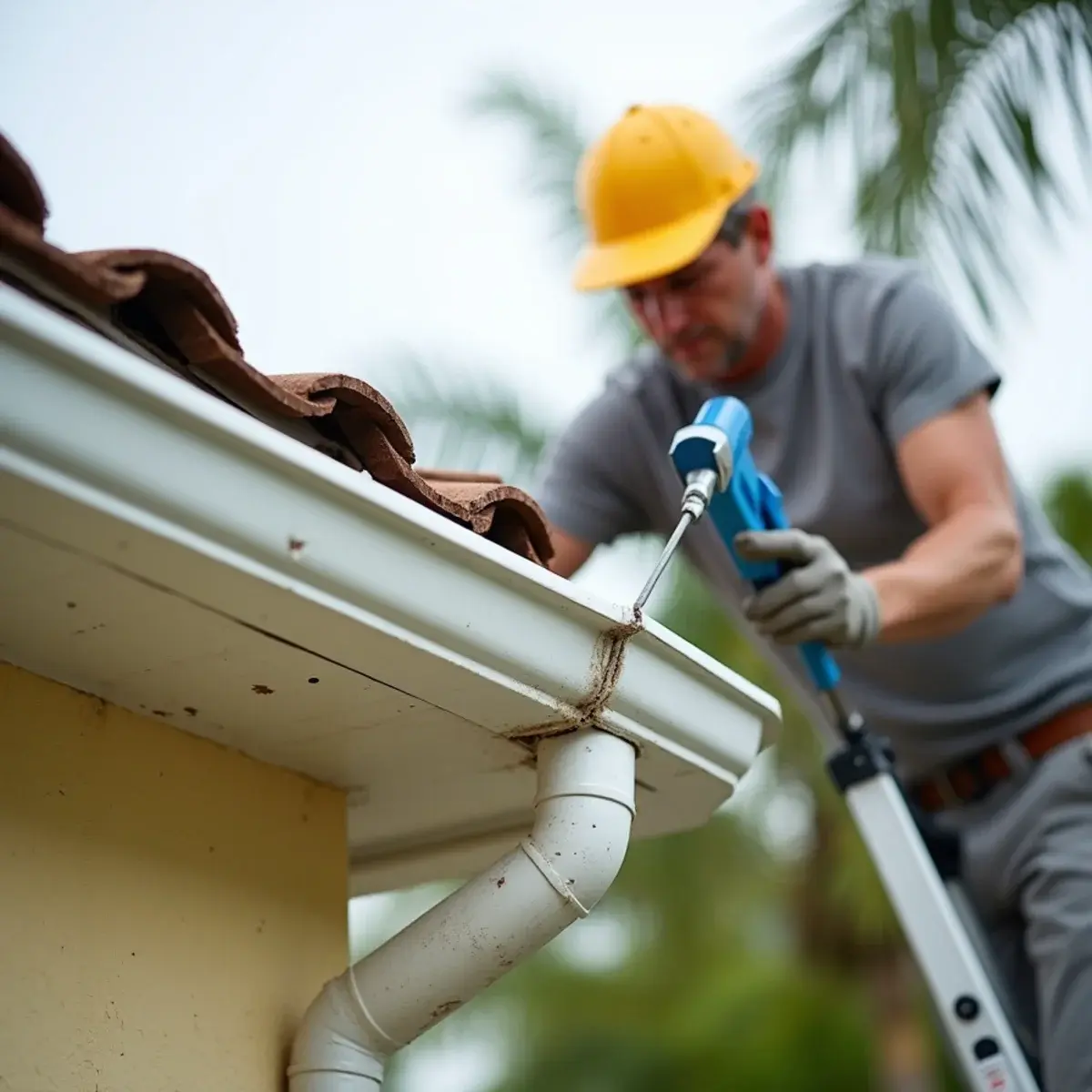
A gutter that drips at the corner or bows in the middle rarely fixes itself. Call (855) 633-0442 and describe what you are seeing; we connect you with an independent installer near you who looks at the run, finds the cause and writes up the fix before any work begins.
Most repairs come down to a short list of causes: sealant that has dried out, hangers that have let go, fascia that has gone soft behind the gutter, or a slope that sends water the wrong way. A good repair goes after the cause. A fresh bead of caulk over a joint that flexes every afternoon will be dripping again by next rainy season.
Gutter problems we fix: leaking corners, separated seams, sagging runs, loose downspouts
Here is what installers find most often when they climb up on a Vero Beach home:
- Leaking corners. Miters, the corner joints, are the most common leak point. Sealant fails, rivets loosen, and water drips straight onto the walkway.
- Separated seams. On older sectional gutters, the slip joints between pieces pull apart as the metal grows in the afternoon sun and shrinks after dark.
- Sagging runs. A run that dips between hangers holds water, gains weight and sags further. Usually a hanger has backed out of softened wood.
- Loose or crushed downspouts. Straps let go of the block wall, elbows get clipped by a mower, and the bottom section gets flattened.
- Weeping end caps. The flat cap at each end is sealed like a corner and fails the same way.
- Holes and corrosion. Pinholes where water has stood for months, and chalky oxidation on thin older aluminum.
- Corroded fasteners and hangers. Rusting screws bleed orange down the gutter face, and a hanger that rusts through lets the run drop a little more with every storm. Near the beach, this is often the first thing to go.
We send installers across Indian River County and into northern St. Lucie County, from Sebastian down to Fort Pierce. If you are not sure your street is covered, check the full list of areas we serve.
Why gutters fail in Vero Beach: wind, salt air, cloudburst rain and heat expansion
Gutters here wear out differently than in colder states. There is no ice season to tear them down. Instead, four forces work on them all year.
Wind
Summer thunderstorms bring gusts strong enough to rock a long run back and forth. Every gust tugs at the hangers, and over the years the screws or spikes loosen their grip on the fascia.
Salt air
Close to the ocean, salt settles on everything. Plain steel screws rust and stain, and thin factory finishes break down. Homes on the barrier island, including Indian River Shores, usually show fastener corrosion long before homes on the mainland do.
Cloudburst rain
Vero Beach averages about 53 inches of rain a year, wettest from June through October. A cell that drops an inch of rain in half an hour fills a gutter faster than the downspouts can empty it. Water that overflows the front, or backs up behind the gutter, finds every weak joint along the way.
Heat expansion
Aluminum grows and shrinks with temperature. A gutter baking on a south wall in July swings a long way between midafternoon sun and a rain-cooled evening. Long sectional runs with rigid joints feel that movement at every seam, which is why joints that were tight on install day open up a few years later.
Storm and hurricane damage: gutters pulled off the fascia
This stretch of coast has a long record of wind damage. In 2004, hurricanes Frances and Jeanne both crossed the Treasure Coast only weeks apart, and many local homes lost gutters, soffit and roofing. On October 9, 2024, the tornado outbreak that came with Hurricane Milton produced two EF1 tornadoes in the Vero Beach area and an EF3 that traveled about 21 miles from Port St. Lucie past Fort Pierce toward Vero Beach. Indian River County counted 51 homes destroyed and more than 500 damaged.
Wind damage to gutters follows a pattern. Gusts catch the front lip, the hangers pull out of the fascia, and the run peels back from one end like a zipper. Sometimes it takes a strip of fascia or drip edge along with it. Downspouts fold at the elbows, and flying debris dents the trough.
After a storm, stay off the roof and keep clear of any gutter hanging at an angle. A long aluminum run can drop without warning. Take photos from the ground and note:
- Runs hanging, twisted or lying in the yard
- Fascia boards cracked, split or pulled away from the rafters
- Missing or bent drip edge along the roof line
- Downspouts torn loose from their wall straps
- Missing soffit panels, which can let wind-driven rain into the attic
For a step-by-step look at the week after a storm, read our post on storm-damaged gutters in Florida.
Rotted fascia and damaged soffit behind the gutter
Fascia is the board along the roof edge that the gutter hangs on. Soffit is the panel on the underside of the overhang that closes it off, usually vented so the attic can breathe. When a gutter leaks at the back or overflows constantly, water soaks into the fascia, and on a lot of local homes that board is wood original to the house.
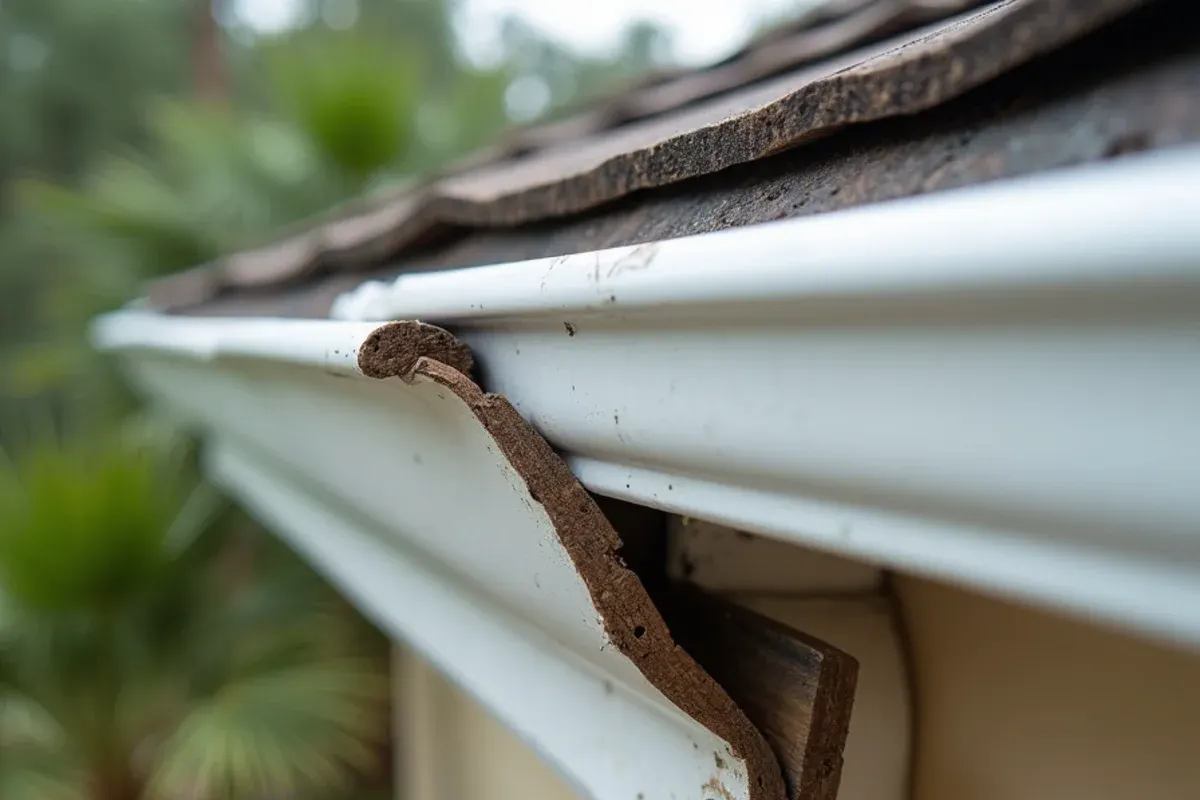
Rot starts quietly. Paint bubbles, the board darkens, and then a screwdriver sinks into it with little effort. Once a hanger sits in soft wood it cannot hold, and the gutter keeps sagging no matter how many times someone re-screws it. A typical fascia and soffit repair runs like this:
- Take down the gutter section over the damaged area
- Cut out and replace the rotted fascia, then prime and paint it or wrap it in aluminum fascia cover
- Replace or refasten damaged soffit panels so pests and wind-driven rain stay out
- Rehang the gutter on new hidden hangers driven into solid wood
Water running behind the gutter: drip edge and slope fixes
If water pours down between the gutter and the house, the gutter itself is often fine. The trouble is the gap above it.
Drip edge is a strip of bent metal flashing along the roof edge that carries water off the shingle and out past the fascia into the gutter. Plenty of older Florida homes were roofed without it, or it got bent during a reroof. Without it, water clings to the underside of the shingle, curls back and runs down the face of the fascia behind the gutter. The fix is to add or replace drip edge, or slide a gutter apron flashing under the first course of shingles so it laps into the trough.
Slope is the other usual suspect. Pitch is the slight fall a gutter needs toward its outlet, only a fraction of an inch over every 10 feet. Gutters that have sagged, or were hung dead level from the start, hold water in low spots. That standing water adds weight, breeds mosquitoes and eventually finds a seam. The installer resets the hangers to restore an even pitch, and may add an outlet in the middle of a long run so the slope does not have to be steep.
Repair or replace: how an installer decides
Repair is usually the right call when the problems are isolated. Replacement starts to make sense when the same failure keeps turning up all around the house.
| What the installer sees | Usually a repair | Usually a replacement |
|---|---|---|
| Leaks | One or two corners or end caps | Leaks at most joints on a sectional system |
| Sagging | A short run with loose hangers in sound wood | Long sags with stretched or kinked gutter metal |
| Fascia | One soft section | Rot along several walls |
| Size | Gutter keeps up once it is clean | 5-inch gutters overflowing in every heavy storm |
| Metal condition | Sound, with a dent or two | Corrosion, pinholes or peeling finish throughout |
| Storm damage | One run pulled down, the rest intact | Several runs torn off or twisted |
The installer should explain the reasoning in plain terms and price both paths when it is close. When replacement wins, it is handled through our seamless gutter installation service, sized for local rainfall. And if the overflow turns out to be a clog rather than a broken part, a gutter cleaning visit may be all the house needs.
Ask for a written condition assessment
A careful gutter repair contractor writes down what was found before recommending anything: which joints leak, which hangers are loose or rusted, where the fascia is soft, how the pitch measures and where each downspout lets out. That report is the evidence behind a repair-or-replace call, and it lets you hand the same list to a second installer and compare proposals on equal terms.
Photos, estimates and your insurer's hurricane deductible
If a storm damaged your gutters, document everything before cleanup. Take dated photos and video from several angles: the whole wall, the damaged section up close, the fascia behind it and any pieces in the yard. Hold on to the parts that came down if you can store them safely.
Coverage depends on your policy, and your insurer decides what gets paid. Many Florida policies carry a separate hurricane deductible for named storms that is figured differently from the everyday deductible. Read your declarations page or ask your agent how yours works before you decide whether to file. Having a written repair estimate in hand first lets you compare the real cost of the work against that deductible.
- Photograph the damage with dates showing
- Make only the temporary fixes needed to prevent more damage, and keep the receipts
- Get a written estimate that itemizes gutters, downspouts, fascia and soffit separately
- Talk with your agent or insurer about your deductible and the claim process
The installer can provide that itemized estimate and photos of what they found up close. Neither the installer nor we can tell you what your insurer will pay.
Storm damage or old wear? Let the photos show both
It helps to show what the storm did and what was already there. Beyond obvious damage, photograph clogged outlets, rust on screws and hangers, gaps where the fascia has separated, stains that show where water has been running, and any corner that overflowed. An estimate that separates fresh storm damage from age, corrosion and skipped maintenance is more useful to you and keeps the claim conversation straightforward.
What affects gutter repair cost
Repair pricing depends on what is broken and what is hiding behind it. The main factors:
- Type of repair. Resealing a miter is a much smaller job than rehanging a whole run.
- Footage involved. How many feet of gutter have to come down and go back up.
- Fascia and soffit work. Replacing rotted boards adds material and labor.
- Height and roof type. Second-story walls and tile or metal roofs take more setup.
- Replacement parts. New sections, corners, end caps, outlets, hangers or downspouts.
- Drip edge or gutter apron, added where water runs behind the gutter.
- Matching. Finding a color and profile that blends with older gutters.
- Disposal of damaged material.
The installer gives you a written price before work starts, so you can decide with the numbers in front of you. Our guide to gutter cost in Vero Beach explains how repair and replacement pricing compare.
Gutter Repair questions from Vero Beach homeowners
Can a leaking gutter corner be resealed, or does the run need replacing?
Most leaking corners can be resealed. The installer scrapes out the old sealant, cleans the metal, checks the rivets or screws and applies fresh gutter sealant inside the miter. That usually holds well when the corner itself is sound. If the miter is cracked, corroded or pulling apart because the run has sagged, it is better to replace the corner piece or fix the hangers first. A whole new run only makes sense when leaks keep appearing at joint after joint.
My gutters came down in a storm. Does homeowners insurance cover them?
That depends on your policy, and your insurer makes the decision, so we cannot tell you what is covered. What helps either way: take dated photos of the damage before anything is cleaned up, keep the pieces if you can, and get an itemized written estimate. Then talk with your agent about your hurricane or wind deductible and whether a claim makes sense. Our post on storm-damaged gutters in Florida walks through the steps.
Why does water run behind my gutter instead of into it?
Usually because there is a gap between the roof edge and the back of the gutter. Without drip edge or a gutter apron, water clings to the underside of the shingle and runs down the fascia behind the gutter. A gutter hung too low, or one that has pulled away from the board, causes the same thing. The fix is flashing that laps into the trough and a gutter reset tight to the fascia. Left alone, it rots the wood.
How soon can someone look at storm-damaged gutters?
Call (855) 633-0442 and we will tell you the earliest available visit with an installer who works your area. After a widespread storm, many homes need help at once, so timing depends on demand. In the meantime, photograph the damage, keep people away from any gutter hanging loose, and move downspout pieces out of walkways. Do not climb onto a wet roof to pull a gutter down yourself. A loose aluminum run is heavier and sharper than it looks.
Can gutter repairs stop water from damaging fascia and landscaping?
Often, yes, when the repair fixes the actual cause. Resealing a leaking miter, replacing a rusted hanger, restoring pitch or reconnecting a downspout puts the water back where it belongs. Fascia that has already rotted needs its own carpentry repair, because a gutter rehung on soft wood will sag again. Beds keep washing out if a downspout still empties into them, so the installer should check where each one discharges. Our downspouts and drainage page covers rerouting.
How soon after a tropical storm should my gutters be checked for damage?
Do a ground-level check the first day the weather allows, then get a closer inspection before the next heavy rain. From the yard, look for a run sitting lower than before, daylight between gutter and fascia, a downspout hanging off the wall or water spilling in a new place, and photograph each one. Hangers loosened by wind often hold for a while and then let go in the next big storm. Call (855) 633-0442 and we will tell you the earliest available visit.
How long does a gutter repair take?
It depends on the scope. Resealing a corner or reattaching a downspout is often a short visit, while replacing rotted fascia and rehanging a run takes longer, and second-story or tile-roof access adds setup time. Matching parts or color on an older system can mean waiting on materials, and rain can push the work back. After a widespread storm, demand sets the pace. The installer gives you an expected timeline with the written estimate.
Last reviewed . We review this page before each rainy season and when code, licensing or county guidance changes.