

Copper is the rare roof-edge material that looks better after years on the house than on the day it goes up. Call (855) 633-0442 and we will connect you with a local installer who works in copper and half-round profiles and can talk through your roof, your architecture and, in many neighborhoods, your community's design rules.
Most people asking about copper here own a barrier island home, a custom house with a tile roof, or an older estate whose original copper has finally opened at the seams. The details decide how long it lasts: the weight of the metal, how the joints are made, and above all what the hangers and screws are made of.
Where copper and half-round gutters fit: barrier island estates, tile roofs, custom homes
Zip code 32963 covers the barrier island, from the older estates of Riomar and Central Beach north past the John's Island area into Indian River Shores. Many of these homes have barrel or flat concrete tile, stucco walls and Mediterranean or British West Indies styling. A white K-style gutter can look out of place there; half-round copper with round downspouts reads as part of the design.
- Custom homes along the river and in the golf communities west of town.
- Older houses where the original gutters were copper.
- Accent runs over an entry portico or bay on an otherwise aluminum-guttered home.
- Oceanfront houses whose owners are tired of replacing corroded fasteners.
The beachside streets off Ocean Drive sit a short walk from the Atlantic coast, and onshore wind carries spray to every roof edge. There, salt air resistant gutters are about hardware as much as looks.
Half-round does not have to mean copper. Painted aluminum half-round gives the profile for less, though without copper's tolerance for beach spray.
Copper vs aluminum near the ocean: salt air, patina and lifespan
Salt air on the island attacks steel fasteners first and thin coatings second. Aluminum gutters can do fine there, but they depend on a sound paint finish and compatible hardware. Copper needs no coating. It protects itself with its own surface layer, the patina.
New copper is bright and pinkish, darkens to penny brown within months, then deepens to bronze. Over years it develops blue-green streaks, usually sooner near the ocean than inland. Some owners want the green; others have the copper treated to hold the brown. Either way, patina is protection, not damage.
| Copper | Painted aluminum | Galvanized steel | |
|---|---|---|---|
| Protection | Self-forming patina | Factory paint finish | Zinc coating that wears away |
| In salt spray | Weathers and darkens, stays sound | Good if paint and fasteners hold; pits where damaged | Rusts once the zinc is gone |
| Looks over time | Brown, then green | Color holds, may chalk | Dulls, then rust stains |
| Fit for oceanfront | Best | Good with proper hardware | Poor |
Lifespan depends on the copper weight (16 oz and 20 oz per square foot are the common residential weights), the solder joints and upkeep. Well-made copper is a multi-decade material. If aluminum suits your budget better, see seamless aluminum gutter installation.
Where vinyl fits on a coastal home
Vinyl cannot rust, which sounds ideal for the coast, but it is the wrong kind of durable here. Strong sun makes it brittle, its snap-together joints loosen as it heats and cools, and a long run lacks the stiffness to ride out hurricane gusts. On a house near the ocean, the real decision is between copper and well-detailed aluminum.
Half-round, K-style and box profiles
Half-round is a half-circle trough, usually 5 or 6 inches across, hung on round brackets. It is the classic traditional look and its smooth interior sheds debris well, though it carries a little less than a K-style of the same width, so big tile roofs may need the larger size.
K-style is the flat-backed profile most Florida homes have. Copper K-style can be formed from coil in continuous runs, for owners who want copper with a cleaner modern line.
Box gutters are deep and square-cornered, hung or built into the roof edge. They carry a lot of water and suit large or flat-roofed modern homes. Built-in box gutters tie into the roof membrane, so a roofer often joins the job.
Avoiding galvanic corrosion: hangers, fasteners and mixed metals
When two different metals touch in moisture, especially salty moisture, one corrodes faster. With copper, the aluminum or steel it touches is what gets eaten. This galvanic corrosion is the most common way a good copper job goes bad.
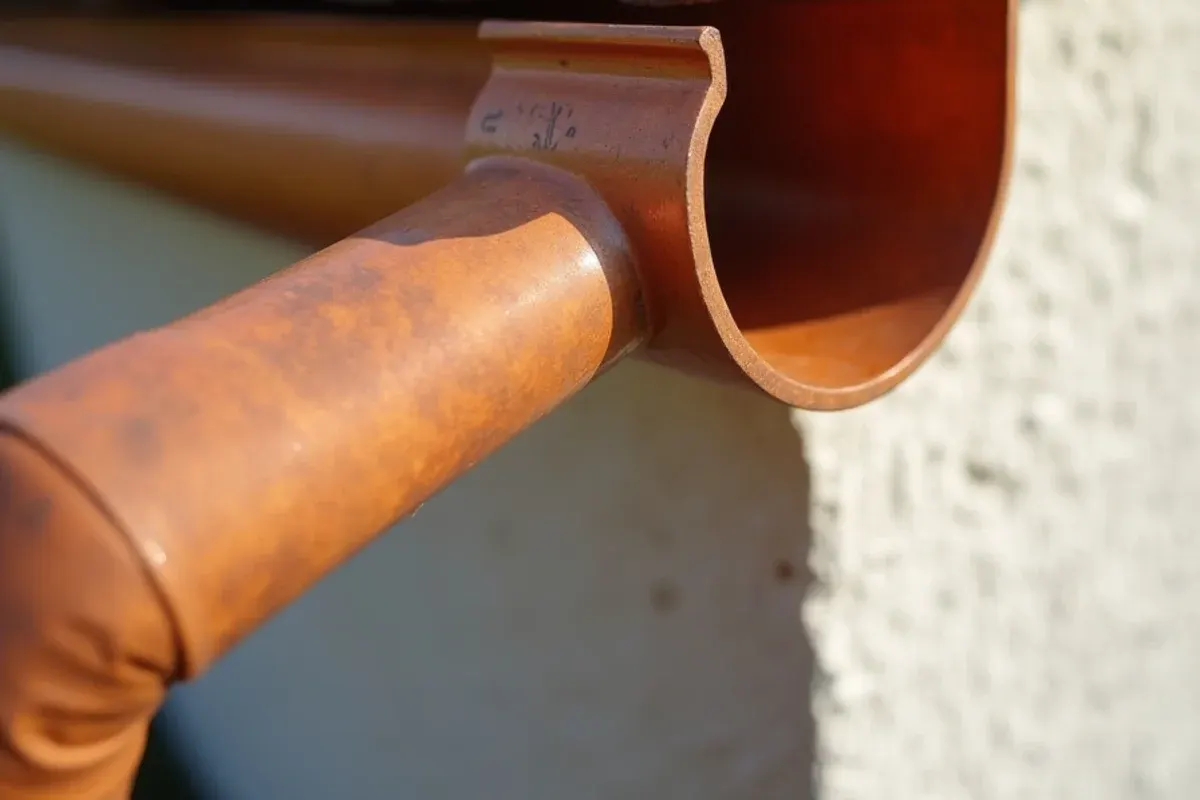
- Hangers and brackets are copper or brass.
- Screws, rivets and straps are copper or brass, never plain or galvanized steel.
- Copper never fastens directly to aluminum drip edge, aluminum flashing or galvanized parts.
- Joints are soldered, not caulked.
Round downspouts, leader heads and other details
Half-round gutters pair with round downspouts, plain or corrugated. The finishing pieces are what make a system look custom:
- Leader heads (conductor heads), the boxes atop a downspout that add capacity at a busy outlet.
- Copper brackets anchored into the stucco.
- Soldered end caps and outside corners.
- Splash pans or a gravel basin at the base so the stream does not stain or erode.
Round copper downspouts can tie into buried lines too; see downspouts and drainage.
Community and architectural review in gated neighborhoods
Many gated communities on the island and in the golf clubs west of town have an architectural review board, and gutters often fall under its rules on profile, color or metal.
- Get the current exterior guidelines from your manager or board.
- Have the installer write up material, profile, size and downspout locations for the submission.
- Allow for the board's review schedule.
- Confirm rules on work hours and contractor gate access.
Owners away for the summer can often arrange approval and scheduling by phone and email with a property manager on site.
How a custom gutter job is measured, fabricated and installed
- Measure. The installer records every run, the roof edge detail, fascia condition and downspout landings.
- Written scope and price listing copper weight, profile, hanger spacing and joint method.
- Fabrication. K-style copper can be formed on site in long runs. Half-round and box gutters come in sections joined with soldered seams; corners and leader heads are often finished in the shop.
- Installation. Hangers go up at close spacing, the gutter is set to pitch and seams are soldered in place.
- Water test and cleanup of every run.
Soldering is skilled work that not every crew does, so ask to see examples. Every gutter installer we send is licensed where Florida requires it, and insured. You can verify any contractor through the Florida DBPR license search at myfloridalicense.com.
Before you sign, ask for proof of the installer's liability insurance and get two warranties in writing: the installer's workmanship warranty on seams, hangers and pitch, and whatever material warranty the copper or coil supplier provides.
What affects the cost of copper gutters
Copper prices follow the metals market, so we do not publish figures. Your installer gives you a written price before work starts. The factors:
- Linear footage of gutter and downspout.
- Copper weight, with 20 oz costing more than 16 oz.
- Profile and width.
- Corners, miters and soldered joints.
- Leader heads, decorative brackets and corrugated downspouts.
- Roof type, height and access.
- Removal of old gutters and any fascia repair behind them.
- Permits and community review.
How a copper proposal should be broken out
Copper is a premium material, usually priced well above aluminum for the same house, so a single lump-sum figure hides where the money goes. Ask for these as separate lines:
- Copper gutter and downspout material, with the weight stated.
- Labor for hanging, pitching and soldering.
- Corners and miters, counted.
- Outlets and leader heads.
- Downspouts, elbows and where each one discharges.
For local pricing context, read gutter costs in Vero Beach. Installers we work with also take on older homes in Fort Pierce and Sebastian; see all of our service areas.
Copper Gutters questions from Vero Beach homeowners
How long do copper gutters last in salt air?
Copper is one of the longest-lasting gutter materials you can use near the ocean, and well-made systems are known to last for decades. Its patina protects it, so salt air weathers the metal rather than eating it. What usually fails first is the detailing: steel fasteners, weak solder joints or contact with aluminum. Heavier copper, copper or brass hangers and soldered seams give the best result on the island.
Will copper gutters turn green?
Yes, eventually. New copper darkens to brown within months and over years develops blue-green streaks, often sooner near the ocean. That patina is a protective layer, not corrosion that weakens the gutter. If you prefer the brown, ask your installer about clear treatments, which need reapplying. Runoff from patinated copper can stain light stucco and pavers, so plan where the downspouts release.
Can aluminum gutters hold up on the barrier island?
Yes, with the right details. Seamless aluminum with a good factory finish does well on many island homes, provided hangers and screws are stainless or aluminum rather than plain steel and cut edges are sealed. Salt finds damaged paint and wrong fasteners first. An occasional freshwater rinse helps. Many owners use aluminum for main runs and copper only on accents.
Do gated communities in Vero Beach restrict gutter styles or colors?
Many do. Gated communities on the barrier island and in the golf clubs west of town often have architectural review boards whose rules can cover gutter profile, color and metal. Some require new gutters to match the originals; others want a written scope or sample first. Get the current guidelines from your manager or board before choosing a style, and have your installer prepare the details for the submission.
Which is better for coastal homes: aluminum, copper, steel, or vinyl gutters?
For most coastal gutter systems in Vero Beach, the practical choice is seamless aluminum with stainless or coated hardware, with copper where the budget and the architecture call for it. Copper handles salt spray best and needs no paint. Galvanized steel rusts once its zinc wears through, which happens quickly near the beach. Vinyl avoids rust but turns brittle in the sun and flexes on long runs. How close the house sits to the ocean usually settles it.
Why do salt-air gutter problems usually start with the hangers and screws?
Because the hardware usually fails before the gutter does. Salt carried inland on the sea breeze settles on hangers and screws, and plain or zinc-plated steel rusts there first, staining the fascia and loosening its grip. Once enough hangers let go, the run sags and overflows. Stainless or coated fasteners for aluminum, and copper or brass for copper, keep the attachment as durable as the trough it holds.
Should I trust a “lifetime” claim on copper gutters?
Treat it as a sales phrase until someone explains it. Ask the installer what service life to expect from the specific copper weight, joint method, hangers and fasteners on your house, given how close it sits to the ocean. Then get the workmanship warranty and any material warranty in writing, with their actual terms. A specific answer is worth more than the word lifetime.
Last reviewed . We review this page before each rainy season and when code, licensing or county guidance changes.