
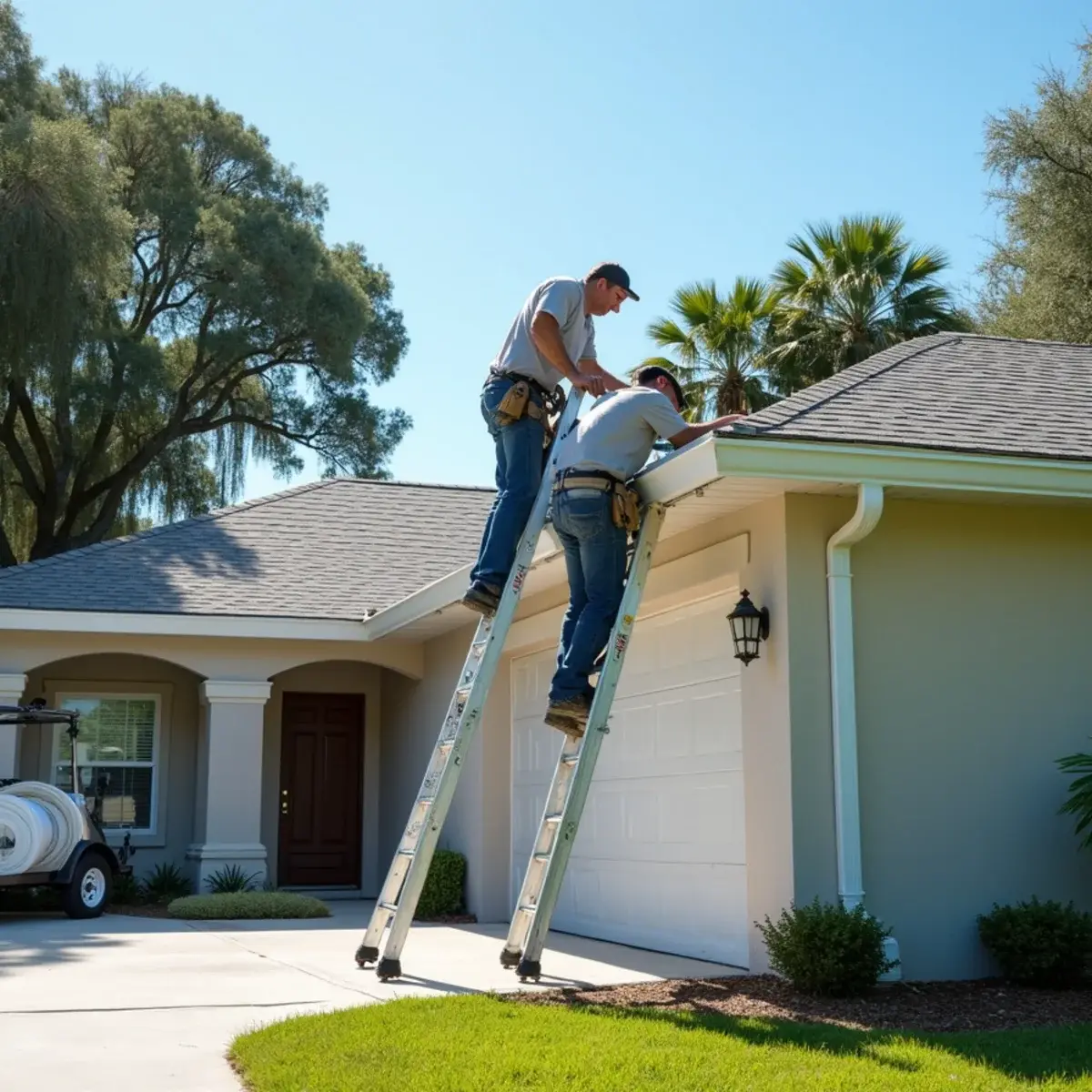
Call (855) 633-0442 and tell us about the house: one story or two, what the roof is made of, and whether it has any gutters now. We match you with an independent local installer who measures the roof edge, talks through sizes and downspout spots with you, and puts a written price in front of you before a single gutter goes up.
Plenty of homes around Vero Beach were built with no gutters at all, or with one short run over the front door and nothing else. On paper that was fine. In practice, roof water drops in a sheet off the eaves, digs a trench in the sand along the house, splashes dirt up the stucco and finds its way under doors and across the lanai. A properly sized seamless system collects that water and sends it where you want it to go.
Does a Vero Beach home need gutters? What 53 inches of rain a year does at the roof edge
Florida does not require gutters on most houses, which is why so many mainland ranch homes from the 1970s and 1980s never had them. The weather did not get that memo. This part of Indian River County averages about 53 inches of rain a year, most of it between June and October, and August alone runs around 7 inches. That rain rarely arrives as a gentle drizzle. It comes in short, heavy afternoon cells that dump a lot of water in a few minutes.
Picture a 40-foot eave on a hip roof during one of those storms. Every square foot of roof above it sheds onto that single edge. Without a gutter, the water lands in the same narrow strip every time, and on sandy soil that strip turns into a ditch. It exposes the edge of the slab, undermines pavers, washes mulch into the lawn and keeps the base of the wall damp.
Signs your house would be better off with gutters:
- A trench or line of bare sand directly under the eaves
- Dirt and mildew splashed up the lowest foot of the stucco
- Water sheeting across the front entry, garage door or lanai screen
- Pavers along the house that have settled, tilted or shifted
- Stained or soft fascia boards where water wraps back under the roof edge (fascia is the board along the roof edge that a gutter hangs on)
Not every wall needs a gutter. Some homeowners only want the entries and the lanai covered; others want the whole perimeter done. The installer can lay out and price both. If you are still on the fence, our article on why Florida homes need gutters covers the trade-offs in more detail.
Seamless aluminum gutters: 6-inch vs 7-inch K-style for Florida downpours
Seamless gutters are formed on site. A portable gutter machine parked in your driveway rolls painted aluminum coil into shape and cuts each piece to the exact length of the wall it will hang on. The only joints left are the corners, called miters, and the outlets where the downspouts connect. Fewer joints means fewer places to leak, which is the whole reason to choose them.
Seamless does not mean one continuous gutter wrapped around the house. Each wall gets its own run, and the runs meet at miters that are riveted and sealed by hand, with end caps on the open ends and outlets where the downspouts drop. Those joints are where a rushed install leaks first.
K-style is the profile on most homes here: a flat back that sits against the fascia and a front face shaped a bit like crown molding. It carries more water than a half-round gutter of the same width. The real decision for a Vero Beach house is size.
| 6-inch K-style | 7-inch K-style | |
|---|---|---|
| Typical fit | Most single-story homes with average roof slopes | Large roof planes, steep pitches, valleys that empty onto one run |
| Downspout pairing | Usually 3x4-inch downspouts | 3x4-inch downspouts, often more of them |
| Heavy summer storms | Keeps up in most storms when outlets are placed well | Extra room for fast water coming off tile and metal |
| Debris tolerance | Good | Wider opening, slower to clog |
| Look on the house | In proportion on most ranch homes | Heavier line that suits larger two-story and estate homes |
Five-inch gutters still hang on a lot of older houses, and they are the size most likely to overflow here. Paired with small 2x3-inch downspouts, they fill and spill over the front edge in an August storm even when they are perfectly clean. Most installers on this coast treat 6-inch as the starting point and suggest 7-inch where a big roof plane or a valley concentrates the flow.
Aluminum, galvanized steel, vinyl or copper?
Aluminum is the default on this coast: it forms on site from painted coil, does not rust, and with stainless or coated screws it makes a salt-air resistant gutter. Galvanized steel is stiffer but rusts wherever its zinc coating gets nicked, and near the ocean that starts early. Vinyl's snap-together sections soften and sag in Florida heat, so it rarely suits a coastal gutter system. Copper is the upscale option for some island homes; see our copper gutters page.
Fitting gutters to shingle, concrete tile and standing-seam metal roofs
Mainland Vero Beach is mostly concrete block homes topped with architectural shingle, concrete tile or metal. Each roof edge asks for something different, and getting it wrong shows up as water shooting over the gutter, water running behind it, or a cracked tile nobody notices until it leaks.
Shingle roofs
Shingles usually hang a short way past the drip edge, the bent metal flashing along the roof line. The back of the gutter tucks up under that flashing so water rolls off the shingle, over the metal and into the trough. If the drip edge is missing or bent, the installer should point it out and price the fix before hanging anything.
Concrete tile roofs
Tile throws water farther and harder than shingle, because the rounded profile channels rain into fast little streams. Gutters on tile homes are often set slightly lower or a touch farther out so those streams land inside the trough instead of over the front lip. Crews work from ladders and the roof edge rather than walking the tile field, since concrete tile cracks under a careless step.
Standing-seam metal roofs
Metal sheds water faster than any other roof. Rain and loose debris slide off at speed, so overshoot is the main worry, and long or steep panels are where the 7-inch size earns its keep. Hangers and screws need to be compatible with the roof metal and the gutter, because dissimilar metals in contact corrode each other over time.
Downspout count and placement on a flat, sandy lot
A gutter only collects water. Downspouts do the real work of getting it off the house, and they are where many installs fall short. Installers figure the count from how much roof drains to each run, not from a fixed number per house. A long run with only one outlet has to be pitched steeply toward it, and that slope is visible from the street. Adding a second outlet in the middle keeps the gutter line straight and halves the load on each downspout.
Where the water lands matters just as much. Most lots around Vero Beach are flat with sandy soil, so water does not run off to the street on its own. A common guideline is to discharge at least 3 feet from the building, and on sand, farther is often better. Options include downspout extensions, splash blocks, and buried drain lines that carry water out into the yard and release it through a pop-up emitter.
- Keep outlets away from entries, walkways and the A/C pad
- Avoid discharging onto pavers, pool decks or inside a screen enclosure
- Aim water toward lawn or a swale, never into a neighbor's yard
- Tuck downspouts into inside corners where they disappear visually
- Use 3x4-inch downspouts on 6- and 7-inch gutters so the outlet is not the bottleneck
Indian River County runs a stormwater program aimed at protecting the Indian River Lagoon, and runoff carrying sand and fertilizer is part of what it tries to reduce. Spreading roof water across a lawn where it soaks in is kinder to the lagoon than piping it straight to a street drain. For bigger drainage problems, see our page on downspout installation and drainage.
Hangers, fasteners and fascia: what holds up in wind and salt air
Older gutters were hung with long spikes driven through the face of the gutter into the fascia every few feet. As the wood swells in summer humidity and dries out again, those spikes work loose, and a strong gust can lever an entire run off the house. Current installs use hidden hangers: brackets that clip under the front lip of the gutter and screw through the back into the fascia. They are spaced closer together, often around every two feet, and they stay out of sight.
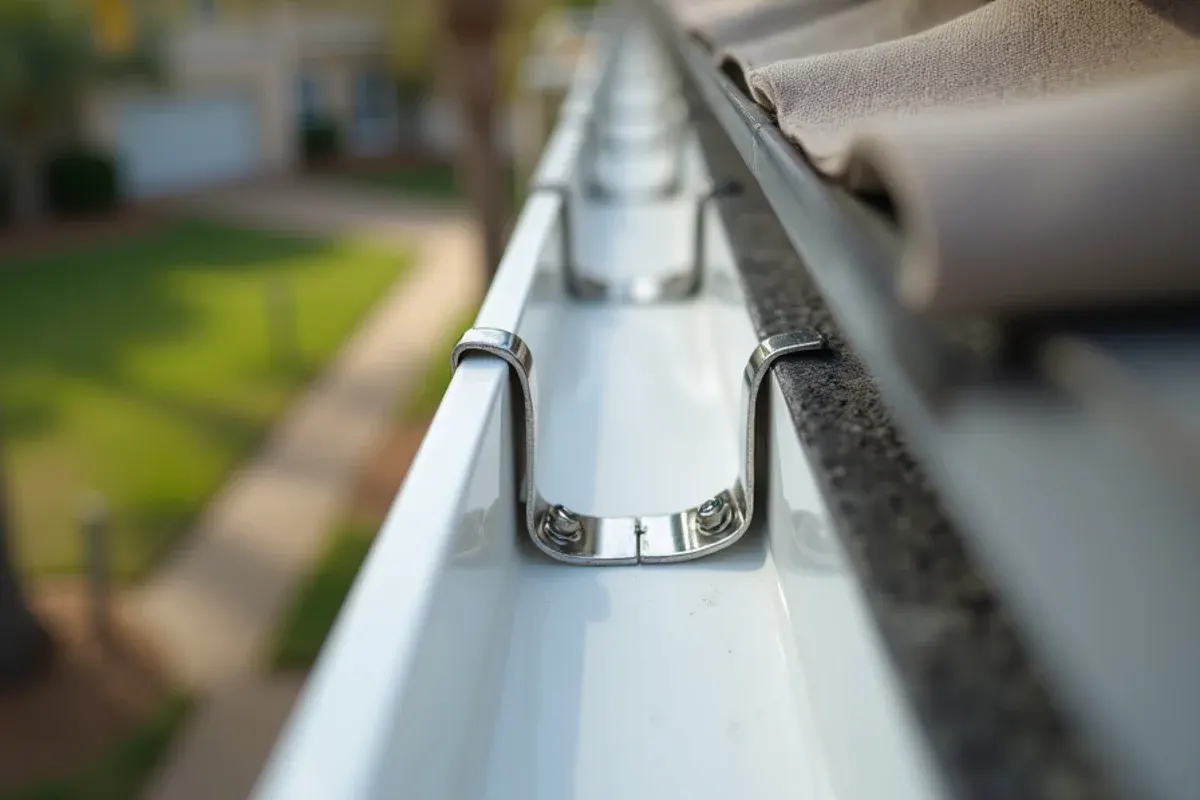
On the barrier island, salt air goes after anything made of plain steel. Zinc-plated screws can bleed rust streaks down a white gutter within a few seasons near the ocean. Ask for stainless steel or fasteners coated for coastal exposure, along with aluminum hangers. Homes in Indian River Shores and along the beachside of Vero Beach show this kind of corrosion years sooner than houses farther inland.
Then there is the board itself. A hanger is only as strong as the wood behind it. The typical home in this area was built in the mid-1970s, and on many of them the fascia is original wood that has taken decades of splash-back. Before hanging anything, the installer presses and probes along each run. Soft or split sections should be replaced first, and that work appears on the written price as its own line.
Gutter replacement: when old sectional or undersized gutters should come down
Sectional gutters come in pre-cut lengths joined with slip connectors along the run. Every joint is held together with sealant, and Florida sun bakes that sealant hard until it cracks. If the seams drip every time it rains, the system is telling you something.
Signs that replacement makes more sense than another round of patching:
- Leaks at several joints around the house, not just one
- 5-inch gutters that overflow in heavy rain even right after a cleaning
- Runs pulling away from the house, with spike holes worn oversized in the fascia
- Peeling paint and white, powdery corrosion along the trough
- Gutters that hold water for days because the pitch, the slight slope toward the outlet, has gone flat
One bad corner or a loose downspout is a repair job, and our gutter repair page covers how those are handled. When problems show up along most of the house, a new seamless system usually costs less over the years than chasing leaks one at a time. Removing and hauling off the old gutters is part of the replacement job.
How installation works: measure, quote, gutters formed on site, cleanup
- Call. Give us the address and tell us what you want covered. We match you with an independent installer who works your part of the coast, from Sebastian south to Fort Pierce.
- Measure. The installer walks the house, measures the linear footage (the total length of all gutter runs), counts corners and outlets, checks the fascia and drip edge, and walks through downspout spots with you.
- Written price. You get a written quote listing size, color, downspouts, hanger type and any fascia work before a date is set.
- Forming and hanging. On install day the crew forms each run to length in the driveway, seals the miters and outlets, sets the pitch and hangs the gutters on hidden hangers.
- Downspouts and testing. Downspouts go up, extensions or drain lines are set, and water is run through so every outlet is confirmed to drain.
- Cleanup. Coil scraps, old gutters and loose screws are picked up and hauled away.
Most single-story homes are finished in a day. Two-story houses, tile roofs and jobs that need fascia replaced first can take longer. Every gutter installer we send is licensed where Florida requires it, and insured. You can look up any contractor on the Florida DBPR license search at myfloridalicense.com and ask about county registration and permits; Indian River County lists gutters among its locally licensed specialty trades.
What a seamless gutter estimate should list
Before you sign, the quote should show:
- Linear footage, wall by wall
- Material, coil thickness, gutter size and color
- Corners, end caps and outlets
- Downspout count, size and discharge points
- Gutter guards, if any, and the runs they go on
- Fascia or drip edge work, or a note that it is excluded
- Any permit, and who pulls it
- Old-gutter removal and disposal
- Warranty terms and payment milestones
- A final water-flow check
Two warranties, two different promises
New gutters usually carry two warranties. The coil maker's material warranty covers the metal and its finish; the installer's workmanship warranty covers the miters, pitch and hangers. Get both in writing, with the length and what voids each. Be wary of a "lifetime" promise that never says whose lifetime, what it covers or who honors it.
Not sure we reach your street? Our Treasure Coast service areas page lists every community we cover.
What affects the cost of new gutters
Every house is measured on its own, so no two quotes look alike. These are the factors that move the number:
- Linear footage. The total length of the runs is the biggest single factor.
- Gutter size. 7-inch uses more coil and heavier hangers than 6-inch.
- Stories and roof type. Second-story walls, steep pitches and tile or metal roofs take more setup and care.
- Corners and miters. Each corner joint adds labor, and hip roofs and L-shaped homes have more of them.
- Downspouts and outlets. How many, what size (2x3 or 3x4) and how far each one drops.
- Drainage add-ons. Extensions, splash blocks or buried lines with pop-up emitters.
- Fascia repair. Rotted boards replaced before the new gutters go up.
- Removal and disposal of old gutters.
- Gutter guards, if you add them at the same time.
- Permits, where the county or city requires one.
The installer puts a written price in front of you before work starts, and nothing gets added without your say-so. For a fuller picture of how pricing works here, read our guide to gutter cost in Vero Beach. Ask your installer for warranty terms on materials and labor in writing.
Gutter Installation questions from Vero Beach homeowners
Do houses in Vero Beach really need gutters?
Florida law does not require gutters on most homes, but many houses here are better off with them. About 53 inches of rain falls in a typical year, mostly in short, heavy storms, and roof water landing on sandy soil cuts trenches along the drip line, splashes the stucco and pools at doors and lanais. Gutters with well-placed downspouts carry that water away from the slab. Some owners cover only the entries and lanai, others the full perimeter, and the installer can price both.
Should I choose 6-inch or 7-inch gutters?
Six-inch K-style gutters suit most single-story homes in Vero Beach and are the usual starting point. Seven-inch makes sense for large roof planes, steep pitches, valleys that empty onto one run, and fast-shedding tile or metal roofs where overshoot is a concern. Either size should be paired with 3x4-inch downspouts rather than the small 2x3 kind. The installer looks at how much roof drains to each wall before recommending a size and can explain the trade-off between capacity and looks.
Can gutters go on a tile or metal roof without damaging it?
Yes, when the crew works from ladders and the roof edge rather than walking across the tile or metal panels. Gutters attach to the fascia board, not to the roof covering, so the tiles and panels themselves are not drilled. On tile, the gutter is set to catch the streams thrown off the rounded profile; on metal, it is placed for fast runoff. Ask how the crew plans to reach your roof edge and how they will protect the landscaping below.
How long does a gutter installation take?
Most single-story homes in Vero Beach are finished in one day, because the gutters are formed in the driveway and hung as each run is cut. Two-story homes, roofs with many corners, tile roofs and jobs that need fascia boards replaced first can run longer. Your installer gives you an expected timeline along with the written quote. Call (855) 633-0442 and we will tell you the earliest available visit to measure your home.
What should a written gutter estimate include?
Enough detail that another installer could price the same job. That means linear footage, material and size, the number of corners, outlets and downspouts, and where each downspout drains. Fascia repair, guards, old-gutter removal and any permit should each be a line or marked excluded, along with warranty terms and payment milestones. Our guide to gutter cost in Vero Beach shows how to compare quotes.
Will new gutters need a permit in Vero Beach or Indian River County?
Sometimes. It depends on the scope of the work and where the house sits. Indian River County requires state-certified contractors to register with the county before they take work there or inside the City of Vero Beach, and a permit applies whenever the work calls for one. Fort Pierce and Lakewood Park follow St. Lucie County rules. Ask your installer who pulls the permit, and check their license on the Florida DBPR search. This is general information, not legal advice.
Last reviewed . We review this page before each rainy season and when code, licensing or county guidance changes.