
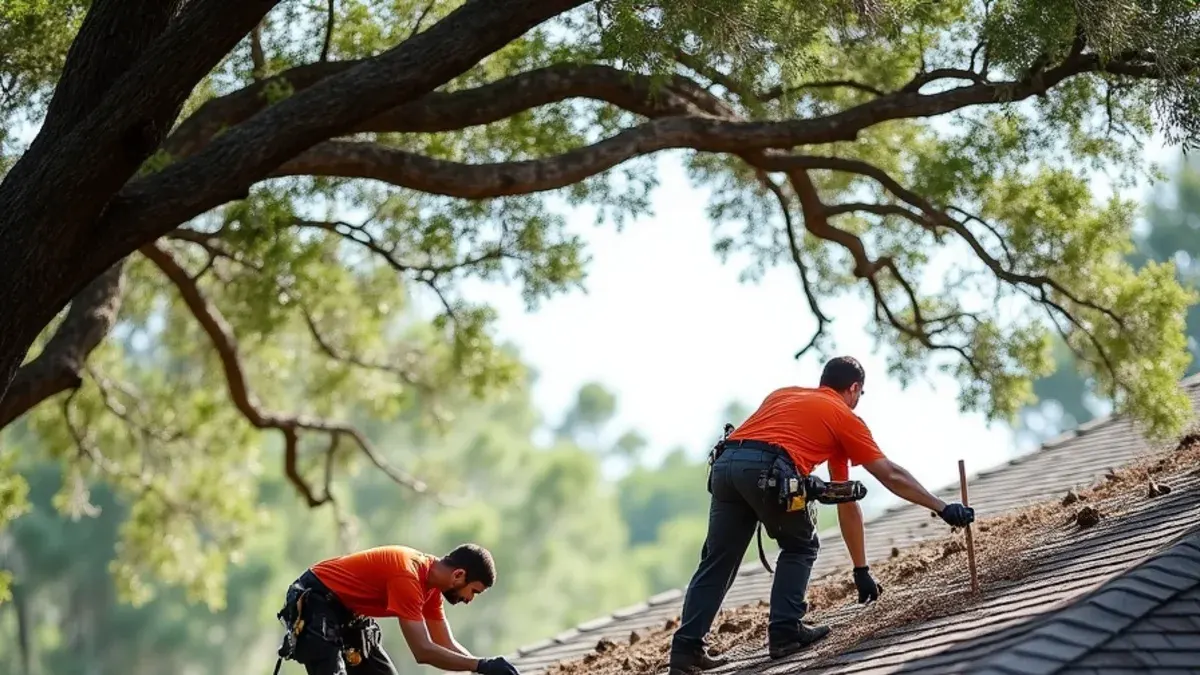
Gutter guards are worth it in Florida when your roof sits under heavy tree cover and you are paying for frequent cleanings or climbing a ladder several times a year. They are not worth it on an open lot with little debris. The type matters as much as the decision: fine micro-mesh handles live oak tassels and pine needles best, while cheap screens let small debris through and trap palm fronds on top. No guard means zero maintenance. Guards reduce cleaning; they do not end it.
Around Vero Beach, trees drop something nearly every month, so there is no single fall cleanup. Here is how each common debris type behaves, and which guards stand up to it.
Guard Types Compared Against Local Debris
| Guard type | Live oak | Pine needles | Palm seeds and fronds | Heavy rain |
|---|---|---|---|---|
| Micro-mesh | Good, blocks tassels and most pollen grit | Good, needles sit on top and blow off | Good for seeds; fronds rest on top | Good if the mesh is kept clean |
| Perforated aluminum | Fair, tassels can mat over holes | Fair, needles poke through | Good for seeds | Good |
| Plastic or wire screens | Poor, small debris passes through | Poor, needles weave in | Fair | Fair |
| Reverse-curve (surface tension) | Fair, leaves slide off | Poor, needles follow the water in | Fair | Can overshoot in downpours |
Ratings are general. Roof pitch, tree height and installation quality all shift the results, which is why an installer should look at your roof and trees before recommending one.
Live Oak: Leaves, Tassels and Pollen
Live oaks are the hardest test. They drop leaves through spring, then shed long stringy tassels (catkins) and a fine yellow pollen. The tassels mat together into a felt that sits on top of a guard and blocks water. The pollen and grit wash into the gutter and settle as sludge.
Micro-mesh is the best match because the openings are too fine for tassels to slip through. Expect to brush the mat off the top once or twice a year. Screens and coarse guards let the fine material in, and then you have a clogged gutter with a cover on it, which is harder to clean than an open one.
Pine Needles
Pine needles are long, thin and drop year-round. In open gutters they form a woven mat that dams water at the outlet. On coarse guards they slip through the holes point first and lodge there, half in and half out.
Micro-mesh stops needles cold, and most blow off a pitched roof once dry. Reverse-curve guards struggle here, because needles follow the water around the curve and into the gutter.
If you are comparing gutter guards for pine needles in Vero Beach, check the low-slope spots first: porch roofs, lanai tie-ins and valley bottoms. Needles that cannot blow off collect there, even on good mesh.
Palm Seeds and Fronds
Palms drop round seeds, flower stalks and whole fronds. Seeds roll into gutters and pile up at the downspout opening. Most guards stop seeds well. Fronds are different: they are too big to enter any guard, so they lie across the top, and the guard cannot remove them.
If palms overhang your roof, trimming dead fronds before hurricane season does more than any guard. A guard keeps the seeds out; the fronds still need a hand.
Guard Types Explained
Micro-mesh
A fine stainless or aluminum mesh over a rigid frame. It blocks nearly everything and handles heavy flow when clean. It is usually the most expensive type, and the mesh needs an occasional brushing.
Perforated aluminum
A solid aluminum panel punched with holes. It is durable and holds up in salt air, but small debris and needles get through.
Screens
Snap-in plastic or wire screens sold at home centers. They stop large leaves and little else, and they sag and warp in Florida sun.
Reverse-curve
A solid hood that relies on water clinging to the curved edge and wrapping into the gutter. Leaves slide off. In a hard downpour, water can shoot right past the edge.
Heavy Rain Overshoot
Any guard slows water entering the gutter a little. During a Vero Beach summer cell, a guard on a steep metal or tile roof can let water sheet straight over the front. Matted debris on top makes it worse.
The fix starts with the gutter. A 6-inch or 7-inch gutter with enough downspouts handles overshoot far better than a guard added to an undersized 5-inch system. Our gutter guard installation page explains how installers match guards to gutter size and roof pitch.
Maintenance You Still Need
- Brush or blow debris off the top of the guard once or twice a year, more under live oaks.
- Check downspouts, which can still clog with fine grit and pollen sludge.
- Look for sagging guards or gaps at corners after storms.
- Have the gutters flushed underneath every year or two, since fine material collects even under good guards.
Many homeowners pair guards with a lighter cleaning schedule rather than none at all. Our gutter cleaning service page covers what a cleaning includes and how often trees around here call for one.
Judging a Guard Proposal Before You Sign
The same guard can work well on one house and disappoint on another. Five things decide which:
| Factor | What to look at on your roof |
|---|---|
| Debris | Which trees hang over which runs, and what they drop |
| Roof pitch | Steep planes push water past a guard; flat stretches let debris sit |
| Product design | Opening size, frame stiffness, how it sheds debris |
| Installation | Fit at corners, valleys and the roof edge; fastening |
| Access | Safe reach for brushing it and lifting it out |
What a straight answer sounds like
- Fine debris and downpours. The installer names what gets through, such as oak pollen grit, and how the guard behaves at your pitch in a summer cell.
- Corners, valleys, outlets and downspouts. You hear whether they get the same guard or a different fix, since clogs start there.
- Getting it off. They show you how a section comes out when an outlet backs up.
- Attachment. You learn whether it screws to the gutter lip, tucks under shingles or needs new hangers, which matters at the next roof job.
- Your part. You get a plain description of the brushing and flushing still on you.
Get the recommendation in writing. Our gutter guard installation page lists what that document should name.
When Gutter Guards Are Not Worth It
- The roof has no trees overhead and the gutters stay mostly clear.
- The existing gutters are undersized, sagging or near the end of their life. Fix or replace them first.
- Only cheap screens fit the budget. They often make cleaning harder.
- The roof is easy to reach and a yearly cleaning is no trouble.
Where guards do pay off is on treed lots. For gutter guards in Sebastian, homes in Sebastian Highlands under pines and oaks are often the strongest case, since those gutters can refill within weeks of a cleaning.
Common questions
What is the best gutter guard for live oak trees?
Micro-mesh is usually the best match for live oaks. Its openings are fine enough to stop tassels, small leaves and most of the grit that comes with oak pollen season. Tassels will still mat on top, so plan to brush the guard once or twice a year. Coarse screens and perforated panels let more of the fine debris through, and that material turns into sludge inside the gutter.
Do gutter guards cause overflow in heavy Florida rain?
They can, especially reverse-curve hoods and any guard with a mat of debris on top. Water from a steep tile or metal roof in a summer downpour moves fast, and some of it can skip the gutter. Correct gutter size, enough downspouts and a clean guard keep overshoot to a minimum. An installer should check roof pitch and gutter size before recommending a guard.
Do I still need gutter cleaning if I have guards?
Yes, but less of it. Guards keep out most leaves, needles and seeds, yet fine grit, pollen and small fragments still wash through and settle in the gutter and downspouts. Debris also builds up on top of the guard and needs brushing off. Most homes with good guards still benefit from a cleaning and flush every year or two, with more frequent checks under heavy oak cover.
Do gutter guards pay for themselves?
Nobody can honestly promise that. Guards cut how often gutters need clearing, and under heavy oak or pine cover that can mean fewer ladder trips. But the guard still needs brushing and an occasional flush, and results depend on your trees, roof pitch and the product. Judge guards on whether they fix a real clogging problem at your house.
Your next step
Gutter guards are worth it on the right house with the right guard. Under oaks and pines, good micro-mesh on properly sized gutters cuts down the ladder work. On an open lot, a yearly cleaning is often the better use of your money. Call (855) 633-0442 and we will match you with a local installer who can look at your trees and roof and give you a written recommendation and price.